

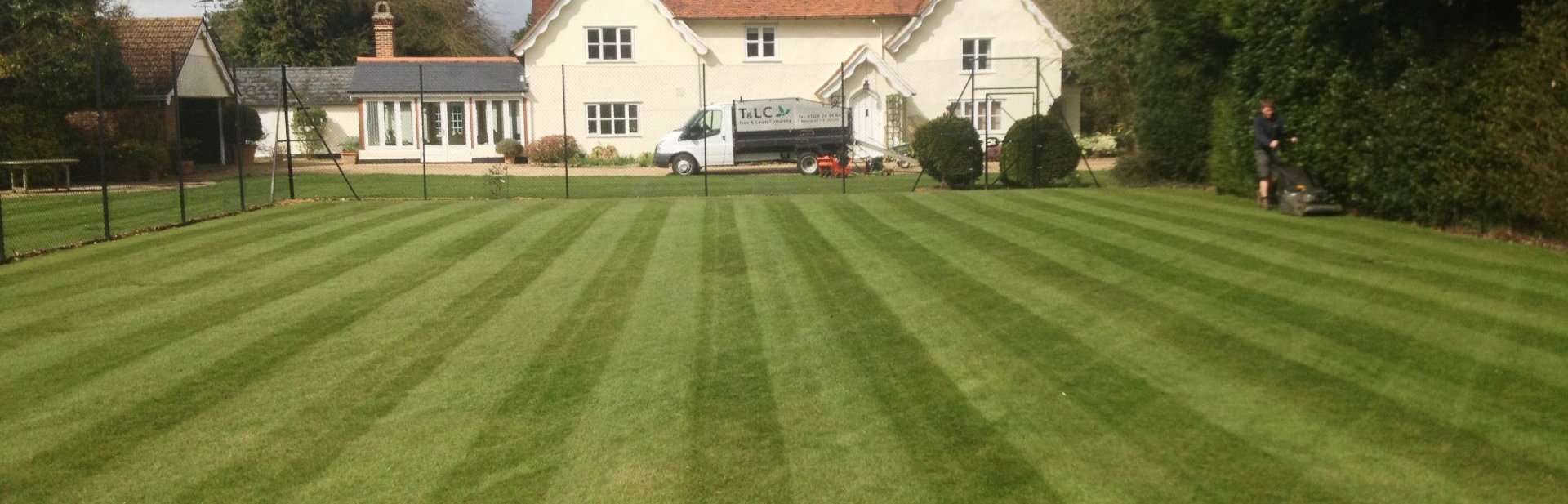
The impact of a well-kept flat lawn is very desirable and, once turf is established, it’s a fairly low maintenance way to achieve a beautifully green outdoor space.
The instant beauty of a turfed lawn
A developer in Romford, enjoyed seeing Tree & Lawn Company’s beautiful transformation with turf. Our video shows this was created in a relatively short time, by bringing in soil and turfing the grounds. Laying turf is a much quicker way to achieve a finished lawn than sowing seeds. It’s usable within just a couple of days. But soil preparation before laying turf is just as important as it is for growing from seed. And it’s not all that instant!
When to turf
To avoid the need for repeated watering, the RHS recommends not embarking on a turfing project from mid-spring until early autumn. With the English weather being somewhat unpredictable, we can sometimes add a little leeway to that timescale.
Soil preparation
All weeds need to be eliminated well in advance, and not with a residual weedkiller. Residual weedkiller can remain in the soil and stop the grass roots from establishing.
The area should be dug over, or rotovated, to a depth of about 20cms and have some well-rotted manure or other organic matter dug in. This is to hold moisture and is especially important on sandy soil.
The soil should then be left to settle for a few days/weeks – the longer, the better.
More weeding!
The next stage is more weeding, this time the newly germinated ones. Best done by hand or with a contact weedkiller. Don’t forget, residual weedkillers can prevent the grass from establishing.
The best lawns have a level surface, and this is achieved by treading and raking several times in each direction. Finally, a general-purpose fertiliser should be raked in.
Laying the turf
Lay the turves on the soil, staggering the joints like brickwork and overlapping them slightly. Work from on the turf, facing forward to the soil and, if it’s a big area, work from a plank of wood to avoid walking on the turf.
Cut off any excess turf with a spade or sharp knife to create a good, clean edge.
Time for tamping
Once all the turf has been laid it can be firmed with a light roller or a home-made ‘tamper’ – consisting of a piece of flat wood attached at right angles to a broom handle. This ensures the turf makes good contact with the soil before giving the whole area a good water. A lawn laid from turf is problem free, so long as it’s kept watered until rooted into the underlying soil.
Looking after your turf
It takes a few weeks for turfed lawns to thoroughly establish and it’s essential you don’t let it dry out. For a beautifully green outdoor space, water new turf regularly, if the rain isn’t already doing the job for you! Start mowing when the grass is between 2.5cm and 5cm high and never remove more than a third of the total height of the grass at a time.
The results can be extremely effective!
https://www.rhs.org.uk/videos/advice/Laying-a-lawn-from-seed-and-turf
https://www.gardenersworld.com/how-to/maintain-the-garden/how-to-lay-lawn-turf/