

What is Ash Dieback?
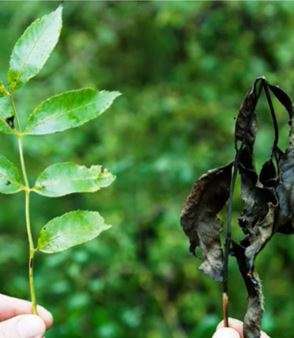
Ash dieback, commonly known as “chalara,” is a highly destructive disease of ash trees brought on by the fungus Hymenoscyphus fraxineus.
Young and coppiced ash trees can be killed quickly by it, but mature trees can withstand it for a longer period of time. Young trees can die from infection within two to three years, and older trees within three to five years.
Associated Risks
Due to the large number of insects, lichens, and mosses that depend on ash as their habitat, the disease has major ramifications for woodland biodiversity.
It also poses a serious health and safety risk, especially near highways, public rights of way, and wooded areas.
As the limbs of infected trees die, they can become extremely dangerous, especially near footpaths and roadways. By removing trees, we can replace them with new, disease-resistant species.
We wrote about this problem over two years ago https://www.treeandlawn.co.uk/common-ash-tree-becoming-less-common/ and, as the situation continues, we decided to investigate further…

Uses For Ash Wood
Ash is a plant frequently grown for its strong and flexible wood. It is perfect for tool handles for axes and spades since it is robust and breaks only with a very forceful blow. Along with skis, coaches, carts, and farming equipment, it also produces quality oars, flooring, hockey sticks, and rackets.
Ash was once regarded to have healing properties and was burned as firewood to ward off evil spirits.
Many sectors may need to think about switching to other hardwoods in the future if the Ash Dieback disease results in a shortage of appropriate timber because ash wood is so widely utilised.
Help Is At Hand
Tree Health Pilot Grant
This support is targeted at Local Authorities that are already dealing with Ash Dieback. Prioritising areas considered high-risk, such as by roadside and footpaths. Their aim is the restocking of resilient trees.
LIFE in the Ravines Grant
Natural England has received a grant of £3.6 million to help restore woodland on the steep ravine slopes in the Peak District Special Area of Conservation. It was awarded by EU LIFE for the LIFE in the Ravines partnership project.
The project aims to restore woodland through woodland management, tree planting and promoting trees with a natural tolerance to ash dieback. Planting on the steep slopes uses use specialist techniques, such as drones, and this grant will provide support.
In addition to the £3.6 million grant from EU LIFE, project partner contributions make a total of £5 million funding for LIFE in the Ravines. The project will run until September 2025.
Ash Timber Innovation Fund
The aim of Woods into Management (WiM), as part of government’s Nature for Climate Fund, is to encourage and broaden innovation in forestry, resulting in improved ecological condition of existing woodlands and the role they play in climate change.
With an initial emphasis on ash, projects need to target novel ways in which woodland habitats can be restored, using market pull to offset woodland management costs and increase the amount of home-grown timber used by British businesses and consumers.
Commercial tree services
Tree & Lawn and other tree surgery companies are able to support with this, with Tree & Lawn servicing Essex and Suffolk, including Braintree, Basildon and Chelmsford.
For more information on Ash Dieback and possible funding:
https://www.forestryengland.uk/
https://www.gov.uk/environment/forests-and-woodland
https://www.gov.uk/government/publications/life-in-the-ravines
https://www.gov.uk/guidance/routes-to-market-for-ash-timber-innovation-fund