
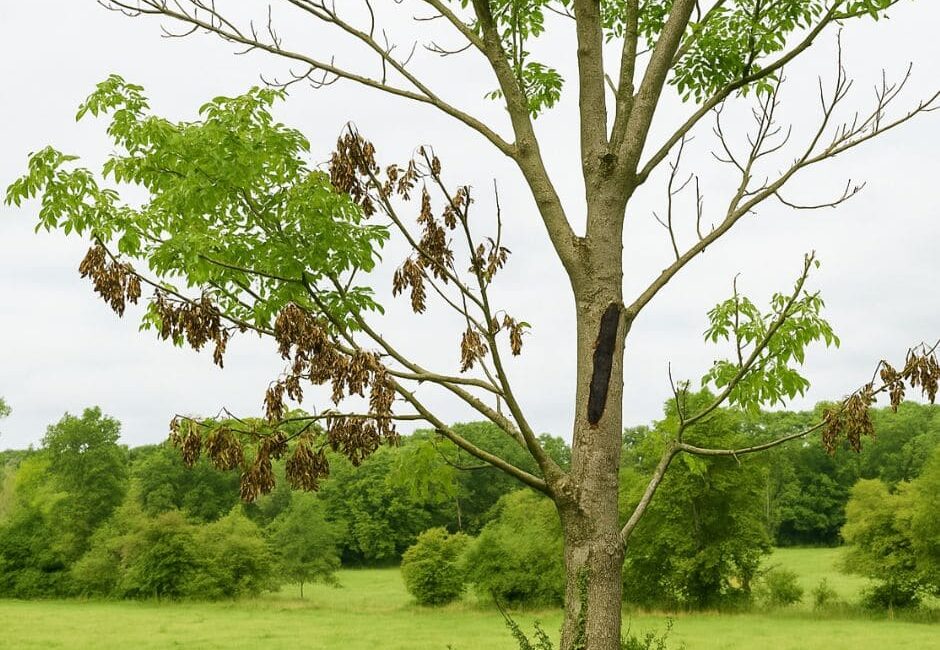
At Tree & Lawn Company we provide a range of expert arboriculture services that help maintain the health of trees. Recently, we have noticed a surge of enquiries from both commercial and residential clients who are concerned about the spread of ash dieback, a disease that represents a serious threat to ash trees across the UK.
What is ash dieback?
Caused by the fungus Hymenoscyphus fraxineus which originated in Asia, ash dieback was first identified in the UK in woodlands in Suffolk and Norfolk in October 2012, just a month later it had spread to Kent and Essex.
It is a highly destructive disease that spreads through wind dispersal of the fungal spores, so it can spread rapidly.
Unfortunately, the disease is causing significant mortality among ash trees throughout much of the UK. Current estimates suggest that 70–80% of ash trees could be lost, which translates to around 70 million trees at the lower end of that range.
The unique ecological importance of ash trees
Ash trees are not only beautiful, but they hold unique ecological benefits that distinguish them from other tree species. Their role in supporting biodiversity, particularly invertebrate life, is crucial. Ash trees host specific insects like the ash bark beetle and the ash flower gall mite, which are integral to the food web, supporting a variety of birds and small mammals that rely on these insects for food.
Furthermore, ash trees have a special relationship with beneficial fungi, including economically valuable species such as morels and truffles. These fungi thrive in the presence of ash, contributing to a biodiverse understory that benefits the entire forest ecosystem.
Another significant advantage of ash trees is the quality of their leaf litter. Ash leaves decompose more quickly than those of many other hardwoods, such as oak, facilitating faster nutrient cycling and enriching the soil more rapidly. This rapid decomposition supports a vibrant ecosystem of microfauna, which in turn sustains larger flora and fauna, enhancing the overall health and sustainability of our landscapes.
Why this matters
Understanding the unique benefits of ash trees highlights the critical need to combat threats like ash dieback. By preserving these trees, we are not only saving a species but also protecting the complex interdependent relationships they foster. Our commitment to managing the health of ash trees is not just about maintaining our green spaces but about preserving these vital ecological functions.
Identification and management
With no current cure, managing this disease effectively is crucial to mitigate its impact on our landscapes. Identifying ash dieback early can significantly help in managing its impact.
Key symptoms include:
- Wilting and discoloration of leaves.
- Dieback of shoots and twigs.
- Lesions on the bark.
Our approach focuses on slowing the spread of the disease through preventative care, treatment and guidance and we only ever remove an infected tree if it poses a risk to safety.
Research and reporting
Scientists studying the DNA of hundreds of ash trees found that a small number were capable of surviving infection, which led them to identify the parts of the genome responsible for this natural resistance.
This knowledge provides vital insight into how quickly ash trees are evolving to produce tolerance to the fungus in the natural environment but is also crucial for any future breeding programmes.
To help with research, when we speak to customers with trees infected by ash dieback we encourage them to notify TreeAlert, an online reporting tool for tree pests and diseases, managed by Forest Research.
Why employ experts?
It is essential to engage skilled professionals who have the experience and training necessary to assess and manage trees affected by ash dieback. A higher level of expertise is crucial for implementing effective strategies to mitigate the risks posed not only by the removal of these trees but also by the disease’s progression and the broader impact on the environment and public safety.
Key risks include:
- Falling branches: Ash trees compromised by ash dieback may have brittle branches that can break off unexpectedly, posing significant risks, particularly in areas frequented by the public such as paths, roads, or buildings.
- Unpredictable tree behaviour: The structural deterioration caused by the disease can alter how trees react during treatment or removal efforts. This unpredictability increases hazards for arborists and nearby properties.
- Secondary infections: Weakened by ash dieback, these trees are more susceptible to additional pathogens like Armillaria fungi, which can further weaken the trees, complicating their management and increasing the risk of sudden failures.
- Hazard to biodiversity: While they pose safety risks, diseased trees are also important habitats for wildlife. Improper management can disrupt ecosystems and negatively affect dependent species.
- Public safety: In urban settings, diseased trees that are not adequately managed pose significant risks. These trees may shed branches or fall, endangering pedestrians, vehicles, and structures.
The importance of preventative tree care
While it is not currently possible to prevent the spread of ash dieback entirely, some of the risks associated with diseased trees can be significantly reduced, or even removed, by taking a proactive approach to tree maintenance. By spotting the early signs of the disease, timely interventions can be made.
Preventative care is therefore key in managing ash dieback, which is why our maintenance programs are designed to preserve the health and longevity of your trees, helping to prevent the escalation of severe damage or loss.
Through these efforts, we can manage the impact of a wide range of diseases more effectively, ensuring that our natural landscapes continue to thrive despite the challenges posed by this and many other diseases.
Practical steps to manage ash dieback:
- Regular inspections: Monitor your ash trees routinely for signs of infection—such as dieback, discoloured leaves, or bark lesions. Early detection enables swift action to slow the spread.
- Targeted pruning: Promptly remove infected branches and dispose of them responsibly. Pruning can also enhance airflow in the canopy, making conditions less hospitable to the fungus.
- Strategic removals: Consider removing severely infected or dangerous trees to reduce the risk of accidents and limit the fungus’s spread to nearby healthy trees.
- Sanitation practices: Clean and disinfect tools, vehicles, and equipment after working on infected trees. This helps prevent the accidental transfer of fungal spores between sites.
- Stress reduction: Keep ash trees healthy by providing sufficient water and nutrients, particularly during heatwaves or droughts. Stressed trees are more vulnerable to infection.
- Species diversification: When planting new trees or replacing lost ones, choose a mix of disease-resistant ash varieties (if available) and alternative species. A diverse tree population is more resilient to future outbreaks.
How we can help
We provide first-class tree care and disease management services, underscored by our accreditation from the Arboricultural Association – our industry body. This gold standard recognition affirms our commitment to excellence and adherence to the highest standards of practice.
Whether you are a commercial or residential client needing a health assessment for your ash trees or strategic advice on managing ash dieback, our skilled team is ready to assist. Led by a highly trained tree surgeon who holds the elite Lantra Professional Tree Inspector award, every case is managed with the highest level of care and diligence.
While ash dieback poses a significant challenge, informed actions and expert care can manage its impacts effectively.
Contact us today to learn how we can help protect your trees and preserve the natural beauty of your environment.