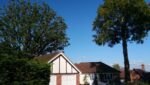
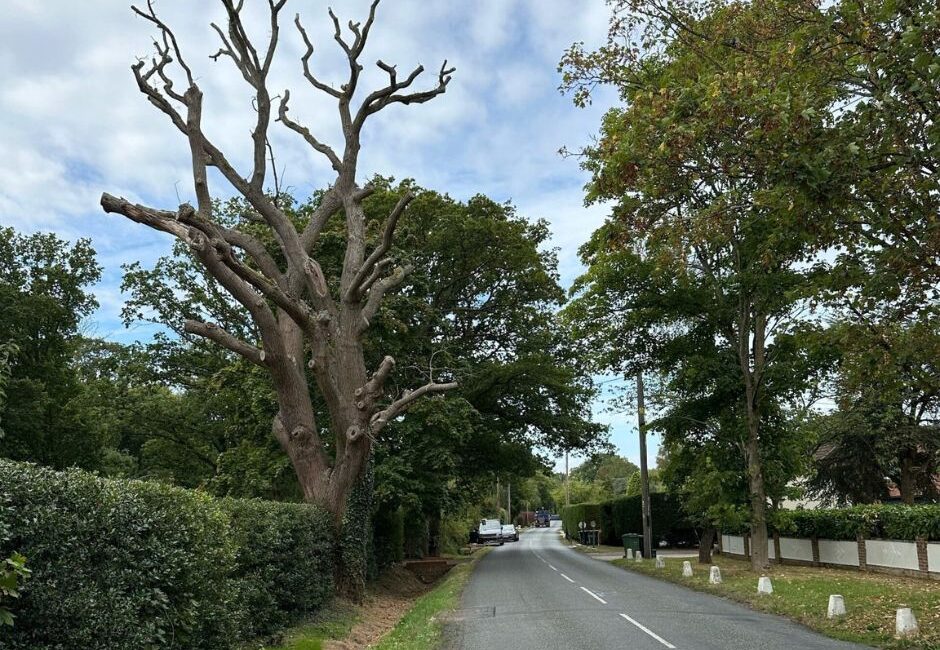
A private homeowner in the Maldon district of Essex reached out to us on the recommendation of his gardener. He had received a letter from Essex County Council regarding a dead oak tree on the edge of his property that is situated close to a public highway and was uncertain how to address the issue.
The letter, which was the result of a recent tree inspection by one the council’s Arboricultural Officers, stated that the tree was a danger to the public and must be reduced in height within 28 days in accordance with the Highways Act 1980, section 154 – Vegetation Encroachment onto Highways.
It also stated that a second inspection would take place at the end of the specified period to ensure that the work had been satisfactorily carried out.
The project
Following an initial visit to assess the tree and provide an accurate quote, our first task once commissioned by our client was to contact the council on his behalf to inform them that we were dealing with the matter promptly.
The next task we undertook was to apply to Maldon District Council to gain consent to carry out the work on the oak because it was covered by a Tree Protection Order (TPO).
Once consent was granted, before starting work, we checked for birds’ nests in accordance with the Wildlife & Countryside Act 1981, and the Countryside and Rights of Way Act 2000, which both stipulate that the nests of wild birds should not be intentionally damaged or destroyed while in use or being built and should be immediately reported to the relevant local authority if discovered.
We also had to be mindful of the possible presence of bats, as trees – oak, beech, and ash trees in particular – are one of their preferred nesting places. Under the Conservation of Habitats and Species Regulations 2010, it is an offence to disturb or damage their breeding sites or nesting places, so contractors who discover the presence of bats must stop work immediately and inform Natural England.
Fortunately, no evidence of wild bird nests or bats were found so we were able to start work as soon as consent was given.
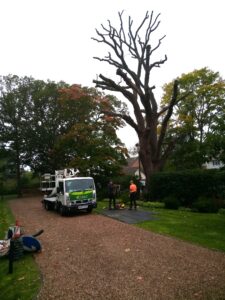
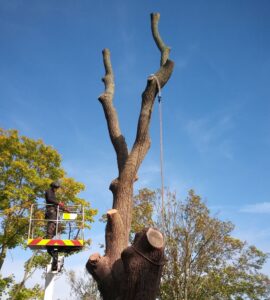
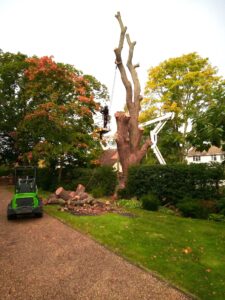
We used our mobile elevated work platform to make it as safe as possible for us to work at height while removing the tree’s large, very heavy dead limbs. We systematically worked our way down to just above the height of the hedge, which enabled us to maintain our client’s privacy, while simultaneously meeting the council’s requirement for public safety.
 The outcome
Our client, Mr Jennings, was delighted with how well the project was handled. He said, “The letter from the council came out of the blue, and I was really quite concerned about getting the work done by the specified deadline.
However, Peter and his team responded quickly to my call and managed the entire process, making a potentially stressful situation no issue at all.
“Tree & Lawn Company were professional, reliable and efficient and I wouldn’t hesitate to recommend them.”